
When Reporting Goes Wrong: How Quickly Can You Recover?
Your reporting system has just generated 19,980 reports successfully. The remaining 20 have failed. What happens next?
For a financial institution producing thousands of client reports, a 99.9% success rate might sound impressive.
But for the reporting team responsible for delivering those documents, the remaining 0.1% can create a disproportionate amount of work.
Which reports failed? What caused the failures? Were the affected documents generated incorrectly, or not generated at all? Can they be recovered individually, or does the entire production run need to start again?
And perhaps most importantly: how quickly can the team resolve the problem without compromising the reports that were already produced correctly?
The real measure of a reliable reporting operation is not simply how often things go right. It’s how effectively the system handles things when they go wrong.
Reporting failures are not always avoidable
Even well-designed reporting systems encounter unexpected problems.
A data source may be temporarily unavailable. A particular client record may contain incomplete or inconsistent information. A connection may fail, a resource may be missing, or an individual report may encounter an exception that prevents it from being generated.
In complex reporting environments, these situations are not necessarily signs of a poorly designed system.
Private banks, asset managers and custodian banks often depend on multiple data sources, applications and interconnected processes to produce their reports.
With thousands of documents, different reporting requirements and strict delivery deadlines, occasional exceptions are a reality that reporting operations need to accommodate.
What matters is whether those exceptions remain isolated, manageable incidents or develop into major operational disruptions.
When a small failure becomes a big problem
Imagine a private bank preparing 20,000 quarterly client reports.
Production runs overnight, and most documents are generated successfully. But when the reporting team arrives the next morning, it discovers that several reports have failed.
In an environment with limited monitoring and error-handling capabilities, identifying the affected documents may require manually reviewing log files, checking production results or comparing lists of expected and generated reports.
Once the failures have been identified, the team still needs to determine what caused them.
Was the problem related to the source data? Did a particular template fail? Was a required service unavailable? Or did something go wrong during document generation?
Additionally, are we sure that no failed reports were sent to any recipients? If they were, what exactly was sent?
Different failures may require different corrective actions.
And if the system cannot restart individual reports, the team may face the prospect of rerunning an entire batch, including thousands of documents that were already produced successfully.
This creates additional processing time, unnecessary resource consumption and potentially another round of validation.
Meanwhile, the reporting deadline is approaching.
Twenty failed reports should not create a crisis involving 20,000 documents.
Yet without effective exception handling and recovery, relatively small incidents can quickly become major operational challenges.
The hidden cost of recovering from reporting failures
The immediate consequence of a reporting failure is often a delay. But the operational impact can extend much further.
Time spent investigating instead of delivering
When reporting teams cannot immediately identify which documents failed and why, valuable time is lost investigating the problem.
Specialists may need to examine technical logs, contact IT colleagues, compare data or reconstruct the sequence of events.
The more fragmented the reporting process, the harder it becomes to understand what actually happened.
Pressure on reporting and IT teams
Reporting deadlines rarely move simply because a production run encountered an error.
When something goes wrong near quarter-end or year-end, reporting and IT teams may find themselves working under considerable pressure to recover the affected documents.
Problems that should be routine exceptions can turn into urgent incidents requiring multiple people to coordinate their efforts.
Unnecessary reprocessing
Regenerating reports that were already produced successfully not only wastes processing resources and creates additional work, it may also introduce new complications, particularly if the underlying data has changed since the original production run.
A recovery process should not create uncertainty about documents that were previously correct.
Operational and reputational risk
Delayed or incomplete reporting can affect internal operations, contractual commitments and client satisfaction.
For financial institutions, where reporting accuracy and reliability are essential to maintaining trust, repeated production problems can become a serious business concern.
And when reporting teams cannot clearly demonstrate what happened during a production run, explaining an incident to management, compliance or auditors becomes more difficult.
Imagine knowing exactly what went wrong
Now consider the same situation in a reporting environment designed to handle exceptions.
A production run generates 20,000 client reports. Twenty encounter errors.
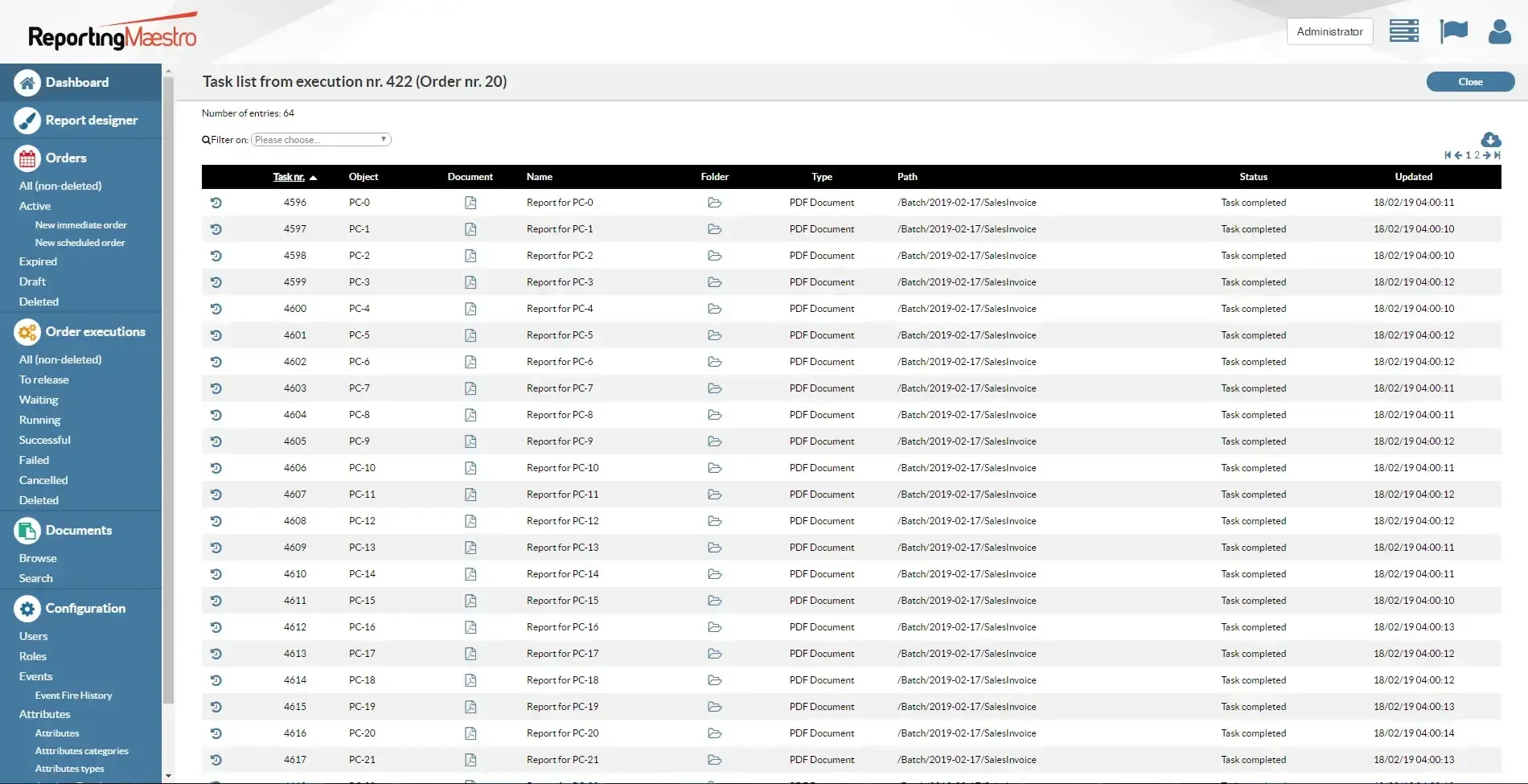
Instead of manually searching for problems, the reporting team can immediately see which documents were completed successfully, which failed and where attention is required.
The system provides information about the errors, helping the team distinguish between data problems, temporary technical issues and other exceptions.
Once the underlying problems have been resolved, the affected reports can be restarted individually.
The 19,980 successful documents remain untouched.
The team can monitor the recovery process, confirm that the outstanding reports have been completed and proceed with the remaining reporting activities.
And because the production and recovery activities are recorded, there is a clear history of what happened.
Instead of spending hours reconstructing a failure, the reporting team can concentrate on resolving it.
This changes the nature of reporting operations.
Unexpected problems no longer automatically mean lengthy investigations, repeated production runs and stressful recovery procedures.
They become manageable exceptions within a controlled process.
Reliability means being prepared for failure
Reporting reliability is often discussed in terms of system availability, processing speed and successful document generation.
These are important measures, but they don’t tell the whole story.
A reporting platform also needs to provide visibility into production activities and support predictable recovery when exceptions occur.
For organisations producing large volumes of business-critical reports, several capabilities make a significant difference:
- Production monitoring: Knowing which reports have been generated, which are still processing and which require attention.
- Error identification and logging: Understanding where and why failures occurred without extensive manual investigation.
- Selective recovery: Restarting affected documents without unnecessarily repeating successful work.
- Traceability: Maintaining a clear record of production activities, exceptions and recovery actions.
- Controlled processing: Managing complex reporting workflows so that errors can be handled without disrupting unrelated activities.
Together, these capabilities help reporting teams maintain control even when unexpected problems arise.
And as reporting volumes increase, that control becomes increasingly valuable.
From firefighting to controlled reporting operations
At ReportingSoft, we understand that producing reports reliably involves much more than generating documents.
Our Reporting Maestro platform is designed to manage complex, high-volume reporting operations, including production monitoring, error handling, selective recovery and traceability.
By bringing these capabilities into a controlled reporting process, organisations can reduce the manual effort involved in investigating and recovering from production failures.
Rather than relying on fragmented scripts, manual checks and lengthy troubleshooting procedures, reporting teams gain greater visibility and control over their reporting activities.
And because Reporting Maestro can integrate with existing business systems, organisations can improve the reliability of their reporting operations without necessarily replacing their underlying banking or investment management platforms.
The objective is not to promise that reporting failures will never occur.
It is to make sure that when they do, your team can respond quickly, confidently and with minimal disruption.
How quickly could your reporting team recover?
Think about the last time a reporting production run failed.
How long did it take to identify the affected documents?
How many people were involved in investigating the problem?
Did you have to restart the entire production run, or could you recover only the reports that failed?
And how much time passed before you could confidently confirm that everything was complete?
If the answers involve hours of investigation, manual checks or unnecessary reprocessing, there may be significant opportunities to improve your reporting operation.
With a resilient reporting system, your reporting team will be recognised for consistently delivering reliable results, even when things go wrong.
Make your reporting system more resilient
Discover how ReportingSoft helps you build a reporting operation where unexpected failures remain manageable, recovery is predictable and your team stays in control.
Request a demo