
Your Legacy Reporting System Still Works. But Is It Holding Your Business Back?
Your reporting system has worked for years. It still produces the reports your organisation needs. So why change it?
It’s a reasonable question.
Many financial institutions rely on reporting systems that have been in place for years, sometimes decades. They are familiar, their limitations are understood, and they continue to produce the documents the business requires.
Replacing them can seem expensive, disruptive and risky.
But there’s another question worth asking:
Is your reporting system still meeting your business needs, or has your business learned to work around its limitations?
The distinction matters. A system doesn’t have to fail to become an obstacle to growth, efficiency and better client service.
When yesterday’s solution becomes today’s limitation
Legacy reporting systems were often developed or implemented to meet a specific set of requirements.
Over time, those requirements change.
A private bank introduces new investment products and more sophisticated client reporting. An asset manager expands into additional markets, currencies and languages. A custodian bank takes on institutional clients with increasingly complex reporting requirements.
Meanwhile, regulatory expectations evolve, reporting volumes increase, and clients expect more personalised information delivered more frequently.
The reporting system may still work, but adapting it to these new demands becomes increasingly difficult.
What once required a straightforward configuration change may now involve custom development, additional scripts, manual processing or complicated workarounds.
And as these modifications accumulate, the system becomes harder and more expensive to maintain.
The business continues to evolve, but the reporting infrastructure struggles to keep up.
The hidden cost of keeping things as they are
One of the strongest arguments for maintaining a legacy reporting system is that the investment has already been made.
The software is installed, employees know how to use it, and the organisation has established processes around it.
But the cost of a reporting system isn’t limited to its licences, infrastructure and maintenance contracts.
There are less visible costs that can become increasingly significant.
Every change becomes an IT project
A relationship manager requests an additional section in a client report. A new institutional mandate requires a different layout. A fund launches a new share class, requiring updated factsheets and reporting templates.
In a modern reporting environment, many of these changes can be handled by business teams using configurable templates and reusable components.
In a legacy environment, even relatively simple changes may require specialist developers, testing and a formal release process.
The result is a growing backlog of reporting requests.
Business teams become frustrated by long turnaround times, while IT departments spend valuable resources maintaining and modifying existing reports instead of working on more strategic projects.
Manual work becomes part of the system
When a reporting platform cannot accommodate new requirements, organisations often compensate with additional manual processes.
Data is exported to spreadsheets. Scripts are introduced to prepare information. Employees manually check documents, coordinate approvals or manage distribution.
Each workaround may seem reasonable when introduced.
But over time, these activities become essential parts of the reporting operation.
The system may still generate reports automatically, yet producing and delivering them requires considerable human effort.
And because these processes often depend on individual employees and their knowledge, they introduce additional operational risks.
Growth creates more complexity
As the organisation grows, reporting requirements multiply.
More clients, portfolios, products and reporting variants mean more documents to produce and maintain.
In an environment built around individual templates, custom developments and manual processes, each additional requirement can increase the workload.
Instead of benefiting from economies of scale, the organisation may find that reporting costs rise alongside business growth.
At some point, the limitations of the reporting infrastructure can begin to influence which services the organisation can offer, how quickly it can onboard new clients and how profitably it can operate.
When the reporting system starts influencing business decisions
Perhaps the most concerning consequence of an ageing reporting environment is that its limitations can begin to shape business decisions.
A client requests a new reporting format, but implementing it would take several months.
A product team wants to launch a new fund, but the required reporting templates are stuck in an IT development queue.
An institutional client asks for more frequent or detailed reports, but meeting the request would require significant additional manual work.
These situations create an uncomfortable choice.
Should the organisation invest time and money in another workaround, delay the request or explain to the client that the desired reporting service isn’t available?
Your reporting system should support your business ambitions, not determine their limits.
For financial institutions competing on service quality, flexibility and client experience, this distinction is increasingly important.
Modernisation doesn’t have to mean replacing everything
One reason organisations hesitate to modernise their reporting infrastructure is the perceived risk of replacing existing systems.
Core banking platforms, portfolio management applications and other business-critical systems represent significant investments.
They contain essential data, support established processes and are deeply integrated into daily operations.
Replacing them simply to improve reporting would rarely be an attractive proposition.
Fortunately, modernising reporting doesn’t necessarily require replacing the systems that provide the underlying data.
A modern reporting platform can work alongside existing applications, connecting to their data and managing the processes required to transform that information into reliable, professional reports.
This allows organisations to preserve their investments in core systems while improving the reporting operation around them.
And rather than continuing to develop individual reports and maintain fragmented processes, the organisation can move towards a more centralised, controlled and scalable reporting environment.
Imagine reporting that can evolve with your business
Consider what becomes possible when reporting is no longer constrained by ageing technology and accumulated workarounds.
Business teams can adapt reporting templates without waiting for every change to pass through IT.
New products, clients and reporting requirements can be accommodated using reusable components rather than developing everything from scratch.
Complex reporting processes can be automated and monitored, reducing dependence on manual activities.
Validation, exception handling, approvals and distribution can become part of a controlled reporting lifecycle.
And when reporting volumes increase, the organisation can scale production without a corresponding increase in operational complexity.
For IT teams, this means less time maintaining legacy developments and responding to routine change requests.
For reporting managers, it means greater control, fewer operational bottlenecks and more predictable production.
For business teams, it means the flexibility to respond more quickly to client requirements.
And for management, it means a reporting infrastructure that supports growth, operational efficiency and better client service.
Modernisation isn’t simply about replacing old technology. It’s about removing the limitations that prevent your organisation from moving forward.
Modernise your reporting operation with ReportingSoft
At ReportingSoft, we help financial institutions modernise complex reporting environments without unnecessarily disrupting their existing business systems.
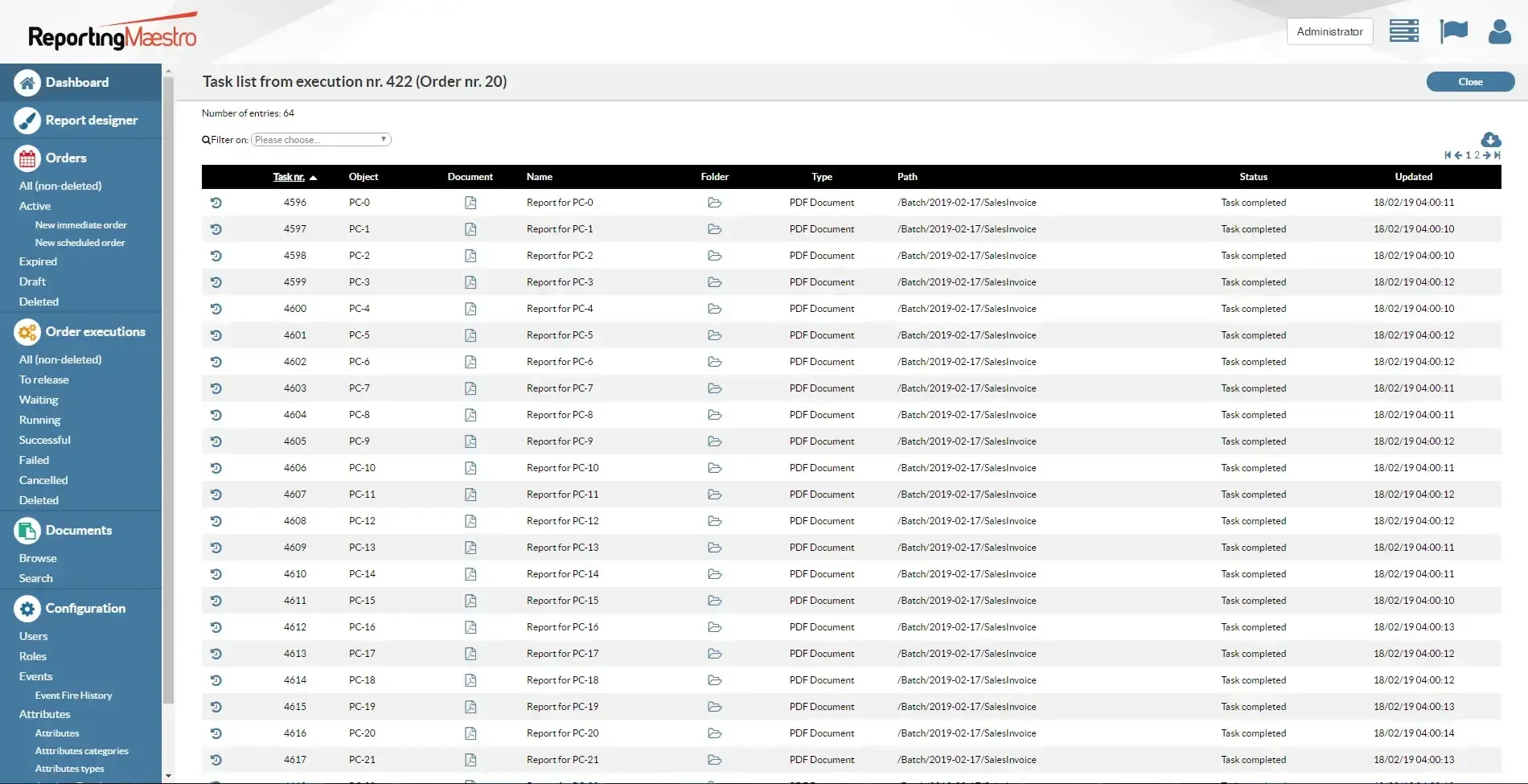
Our Reporting Maestro platform is designed to integrate with existing applications and manage the complete reporting lifecycle, from data integration and document production to validation, exception handling, controlled distribution and archiving.
Combined with Business Report Designer, it enables business users to create and maintain sophisticated reporting templates without depending on IT development for every change.
For organisations relying on ageing reporting technologies, ReportingSoft also provides expertise and tools to support controlled migration to a modern reporting environment.
This includes the ability to compare existing and newly generated documents, helping organisations verify that reporting output remains consistent during the transition.
Our consultancy services help organisations assess their existing reporting architecture, identify operational bottlenecks and determine where modernisation can deliver the greatest business value.
The objective isn’t to replace technology simply because it’s old.
It’s to create a reporting environment that is easier to maintain, more flexible, more reliable and better equipped to support future business requirements.
Is your reporting system still fit for the future?
Think about the last few reporting requirements your organisation received.
How long did they take to implement?
How much IT involvement was required?
How many manual processes or workarounds were necessary?
And have you ever delayed or declined a business request because your reporting system couldn’t accommodate it easily?
If these questions sound familiar, your reporting infrastructure may already be costing your organisation more than you realise.
A reporting system that still works isn’t necessarily a reporting system that still works for your business.
Remove limitations. Free your business.
Discover how ReportingSoft helps modernise your reporting environment to improve efficiency, flexibility and reliability while protecting your existing investments.
Request a demo