
How Much of Your Reporting Process Is Still Manual?
Your reporting system produces thousands of documents every month. But how much effort does it take you to get them out of the door?
In many financial institutions, reporting is considered “automated”. Reports are generated by software, data is retrieved from databases, and documents are produced in formats such as PDF, MS Word etc.
Yet behind the scenes, reporting teams may still have to spend hours preparing data, running scripts, checking spreadsheets, correcting errors, managing approvals and distributing documents.
The reports may be generated automatically, but the reporting process is anything but.
And as reporting volumes grow, client expectations increase and deadlines become tighter, these manual activities can become an increasingly expensive and risky part of the operation.
The hidden manual work behind automated reporting
Consider a typical quarter-end reporting cycle in a private bank.
Before reports can be generated, data must be collected from different systems. Some information needs to be reconciled, other data checked for completeness, and exceptions investigated.
Once production begins, someone needs to monitor the process. If reports fail, the team must identify what went wrong, correct the problem and determine which documents need to be generated again.
Then come the final checks, approvals and distribution.
And throughout the process, people are coordinating activities, exchanging emails, updating spreadsheets and making sure nothing has been overlooked.
Even when the actual document generation takes only minutes, the surrounding work can consume days.
The question is not simply how quickly your system can generate reports. It’s how much effort your organisation needs to invest before those reports safely reach their recipients.
When manual processes become a business problem
Manual reporting activities are not necessarily a problem when volumes are small and requirements are simple.
But financial institutions rarely operate in such straightforward environments.
A private bank may need to produce thousands of personalised portfolio reports within a narrow reporting window.
An asset manager may need to maintain factsheets, performance reports and client documents across multiple funds, currencies and languages.
A custodian bank may serve institutional clients with different reporting requirements, formats, frequencies and contractual deadlines.
As these demands increase, manual processes become harder to manage.
More clients mean more reports. More reporting variants mean more preparation and checking. More complex requirements mean more opportunities for errors and delays.
And the usual response is to allocate more people, extend working hours or introduce additional manual controls.
This may keep the operation running, but it doesn’t address the underlying problem.
Your reporting workload grows with your business, even when the technology should be making that growth easier to manage.
The cost goes beyond working hours
The most obvious cost of manual reporting is the time employees spend on repetitive tasks.
But the consequences reach much further.
Errors and operational risk. Manual data preparation, document checks and recipient matching introduce opportunities for mistakes. In financial services, an incorrect report or confidential information sent to the wrong recipient can have serious consequences.
Delays and missed deadlines. When reporting depends on several manual activities, one unexpected problem can disrupt the entire schedule. Teams may find themselves working under considerable pressure to meet client or regulatory deadlines.
Limited flexibility. A new client requirement, additional language or change to a report template can create more work for an already busy team. Even relatively simple changes may need to wait for IT resources.
Dependence on individuals. When reporting processes rely on scripts, spreadsheets and procedures understood by only a few specialists, the organisation becomes dependent on their availability and expertise.
Increasing operational costs. As reporting requirements become more complex, maintaining the existing process may require additional staff, external support or increasingly expensive workarounds.
Perhaps most importantly, all this effort takes valuable time away from activities that could genuinely improve the reporting service.
What could your reporting team achieve without all that manual work?
Imagine a different quarter-end.
Data is retrieved and processed automatically from existing systems, reporting processes execute in the required sequence without the need for manual intervention, and documents are generated according to predefined schedules and business rules.
Validation takes place as part of the process rather than relying on manual checks afterwards.
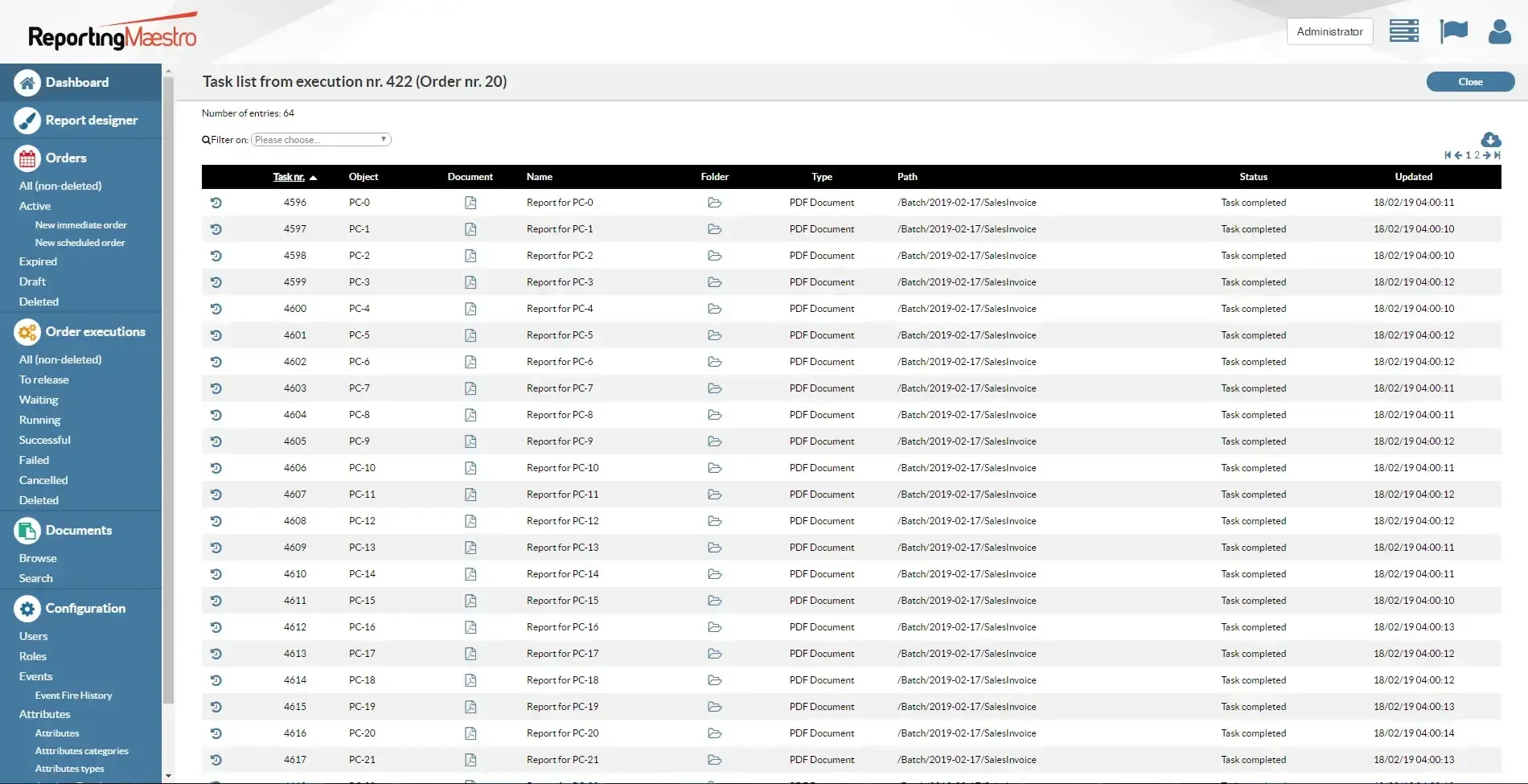
The reporting team can monitor production, see which documents have been completed and identify exceptions that require attention.
If something goes wrong, the affected reports can be corrected and regenerated without restarting an entire production run.
Approved documents are distributed through controlled channels, and the reporting history remains available for future reference and audit.
Instead of spending their time managing routine production activities, reporting specialists can concentrate on exceptions, quality improvements and new business requirements.
IT teams spend less time maintaining scripts, implementing changes and investigating failed reports.
And the organisation can respond more confidently when clients request more complex reporting with increased frequency, or require further details about specific process runs for audit purposes.
The reporting team is no longer simply keeping the process running. It is helping the organisation deliver a better service.
Automation means more than generating documents
Many reporting systems automate document creation. Far fewer address the complete operational process surrounding it.
Yet generating a report is only one part of the reporting lifecycle.
Data preparation, validation, production scheduling, exception handling, approvals, distribution, archiving and traceability all contribute to the final result.
When these activities are handled by separate tools and manual procedures, the organisation may still face many of the challenges associated with traditional reporting.
A modern reporting operation brings these activities together in a controlled, automated process.
And importantly, modernising reporting doesn’t necessarily mean replacing existing banking, investment management or other core systems.
It means making better use of those systems by connecting them to a reporting platform capable of managing the complete process, from data to delivery.
Make your reporting operation work for you
At ReportingSoft, we help financial institutions modernise complex reporting operations.
Our Reporting Maestro platform is designed to automate and orchestrate the reporting lifecycle, integrating with existing systems while providing the production controls, monitoring, exception handling and traceability that demanding reporting environments require.
Combined with Business Report Designer, it also gives business teams greater flexibility to create and maintain sophisticated reporting templates without relying on IT development for every change.
And because every organisation has different systems, requirements and operational challenges, our consultancy services help identify where automation can deliver the greatest value.
The objective is not simply to produce more reports, faster.
It is to reduce operational effort, improve reliability, support growing reporting requirements and give your teams more control over the entire process.
How much of your reporting process could be automated?
If your reporting team still spends significant time preparing data, running scripts, checking documents, managing exceptions, investigating errors or coordinating distribution, there may be considerable opportunities for improvement.
Imagine what your team could achieve if those activities no longer dominated the reporting calendar.
Automate your reporting process
Discover how ReportingSoft helps you move towards a more automated, reliable and scalable reporting operation.
Request a demo