
When a Reporting Error Becomes a Compliance Issue
A client calls to question a figure in their quarterly portfolio report.
The reporting team investigates and discovers that an outdated valuation was used. The correct report is generated, the client receives an explanation, and the immediate problem is resolved.
Or is it?
A few days later, Compliance asks some additional questions.
How did the outdated figure enter the report? Were other clients affected? Who approved the original document? When was the error discovered, and what happened between discovery and correction?
And perhaps most importantly: Can you demonstrate exactly what happened, or are you relying on people to remember?
What initially looked like a straightforward reporting error has become a compliance issue.
The mistake is only part of the problem
In financial services, reporting errors can have consequences that extend well beyond an incorrect figure or an unhappy client.
Some mistakes are relatively easy to correct. Others may expose confidential information, mislead clients, or raise questions about whether the organisation’s internal controls are working as intended.
For a regulated financial institution, being able to explain what happened is often just as important as correcting the mistake.
Can you reconstruct the reporting process?
Imagine that an internal audit identifies an inconsistency in a client report issued six months ago.
The auditor wants to understand how that particular document was produced.
Which data and template versions were used? Which checks were completed, by whom and when? Who authorised the release? Who received the document? Was it subsequently corrected or replaced?
In an organisation where reporting involves multiple systems, scripts, spreadsheets and manual procedures, answering these questions can become surprisingly difficult.
Information may be scattered across application logs, shared folders, emails and individual team members’ records.
The people involved may have moved to different roles. Systems may have changed. Some records may no longer be readily available.
Reconstructing the history of a single report can require hours or even days of investigation.
And the more difficult it is to reconstruct that history, the harder it becomes to demonstrate that the reporting process was properly controlled.
When everyone did their job, but nobody can prove it
A reporting process may include several layers of checks and approvals.
Yet the existence of these procedures does not necessarily mean there is reliable evidence that they were followed for every report.
Perhaps an approval was given in an email. Perhaps someone confirmed it during a meeting. Perhaps the team followed its normal procedure, but the individual confirmation was never recorded.
There is an important difference between having a control in place and being able to demonstrate that the control was applied.
That distinction becomes particularly significant during audits, investigations and regulatory reviews.
One error can raise questions about thousands of reports
When an error is discovered, one of the first questions is often whether it was an isolated incident.
The reporting team needs to establish the scope of the problem quickly and confidently.
Without sufficient traceability, this can become a major exercise involving IT, Operations, Compliance and potentially senior management.
The organisation may have to examine large numbers of documents simply because it cannot reliably identify which ones were affected.
Meanwhile, decisions about client communication, corrective action and any applicable regulatory obligations may be delayed.
The cost of a reporting mistake is not necessarily determined by the number of incorrect reports. It can also depend on how difficult it is to establish which reports were affected.
Compliance should not depend on detective work
Much of the required information already exists.
But it may not be consistently captured or linked to the individual report.
The organisation is then left assembling fragments after something goes wrong.
This creates unnecessary work for Reporting, Compliance and internal audit.
It also increases dependence on individual employees who understand the systems and remember how particular processes operate.
A more controlled reporting environment changes that situation.
Rather than reconstructing events retrospectively, the organisation can refer to records created as part of the normal reporting process.
Checks, approvals, exceptions, corrective actions and distribution activities become traceable.
When questions arise, the people responsible can concentrate on understanding and resolving the issue rather than searching for evidence.
What would greater confidence look like?
Imagine being able to respond to an auditor’s questions about a particular client report without launching a lengthy investigation.
Or discovering a reporting error and quickly establishing which documents were affected, which clients received them and what corrective action is required.
Imagine a reporting team that does not have to search through emails to establish whether a report was approved, or ask IT to piece together information from several disconnected systems.
For Compliance, this means greater confidence in the reporting operation and better access to the evidence needed for oversight.
For Operations, it means less disruption when something goes wrong.
For management, it means greater assurance that reporting risks are understood and controlled.
And for clients, it means dealing with an organisation that can respond to problems clearly, promptly and professionally.
Building accountability into the reporting process
Achieving this level of control requires more than generating accurate documents.
The reporting process itself needs to be managed, with visibility over the activities involved and reliable records of what happens along the way.
This is where a governed reporting platform can make a difference.
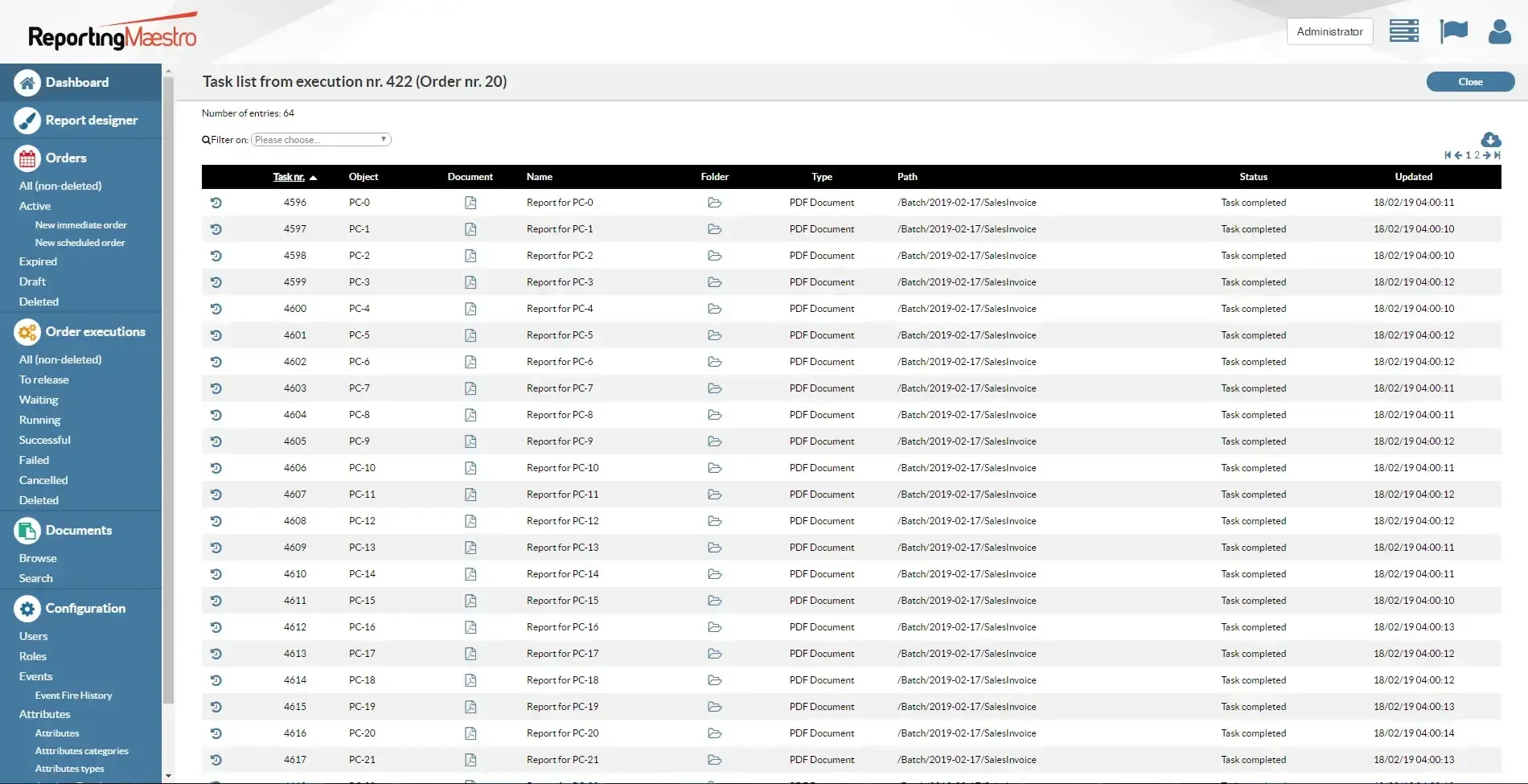
ReportingSoft’s Reporting Maestro helps organisations coordinate and control complex reporting operations by monitoring execution, managing exceptions and maintaining an audit trail. In the opening scenario, this gives the reporting team a clearer starting point for investigating what happened and which reports may have been affected.
By bringing reporting activities into a controlled process, organisations can reduce their dependence on disconnected procedures and make it easier to understand what happened when something goes wrong.
The objective is not to eliminate every possible reporting mistake. No system can guarantee that.
It is to make the reporting operation more transparent, accountable and resilient.
A reporting error does not automatically have to become a compliance issue. But an inability to explain what happened can make a difficult situation considerably worse.
How quickly can you explain a reporting error?
Let’s talk about how Reporting Maestro can help you strengthen controls, improve traceability and respond confidently when questions arise.
Request a demo