
When Reporting Depends on Everything Happening in the Right Sequence
Your reporting system is ready to generate the reports. But is everything else ready?
In complex financial institutions, producing a client report often involves much more than retrieving data and generating a document.
Portfolio valuations must be completed. Transactions need to be reconciled. Performance calculations must finish. Data from different systems needs to be collected, processed and validated.
And these activities frequently depend on one another.
One system must finish its work before another can begin. Some processes run in parallel, while others must wait for specific results. Only when all the required information is available can report generation proceed.
Then come further activities: validation, approvals, distribution and archiving.
Each step may involve a different application, service or department.
The challenge isn’t simply generating reports. It’s making sure that everything happens in the right sequence, at the right time, with the right information.
When reporting becomes a chain of dependencies
Consider a private bank preparing its quarterly portfolio reports.
Before production can begin, the core banking system must complete its end-of-period processing.
The resulting data is then passed to another application for performance calculations. Those calculations may need to be combined with information from risk management systems and other sources.
Only when the required processes have finished successfully can the reporting platform generate the client documents.
But the process doesn’t necessarily end there.
Generated reports may need to undergo additional checks, pass through an approval workflow or be transferred to another system for distribution.
Finally, documents and their associated information must be archived for future retrieval and audit purposes.
In practice, the reporting operation may involve numerous interconnected systems, each with its own processing schedules, dependencies and potential exceptions.
And the complexity increases when different report types, clients or business units require different workflows.
A reporting process is only as reliable as the coordination between the systems it depends on.
What happens when one system isn’t ready?
Imagine that a performance calculation takes longer than expected.
The reporting system is scheduled to start at 6 a.m., but the required data won’t be available until 6:30.
What happens next?
In a fragmented reporting environment, the answer may depend on how the various systems have been connected.
Perhaps a scheduled job starts anyway, producing errors or incomplete results.
Perhaps the reporting process fails and someone must restart it manually.
Or perhaps the team has introduced an additional delay into the schedule to allow enough time for the preceding process to finish.
That last approach may seem practical, but it introduces another problem.
If the preceding process finishes early, the reporting system still waits unnecessarily. If it takes longer than anticipated, the delay may not be sufficient.
And when several systems depend on one another, these uncertainties accumulate.
A delay in one process can affect everything that follows.
What should be a predictable reporting operation becomes a collection of schedules, scripts and manual interventions that require constant attention.
The hidden cost of coordinating systems manually
Many financial institutions have invested heavily in their core banking, portfolio management, risk management and other business applications.
These systems may perform their individual tasks extremely well.
The difficulties often arise in the processes connecting them.
When orchestration is handled through separate scripts, scheduled jobs and manual procedures, several challenges can emerge.
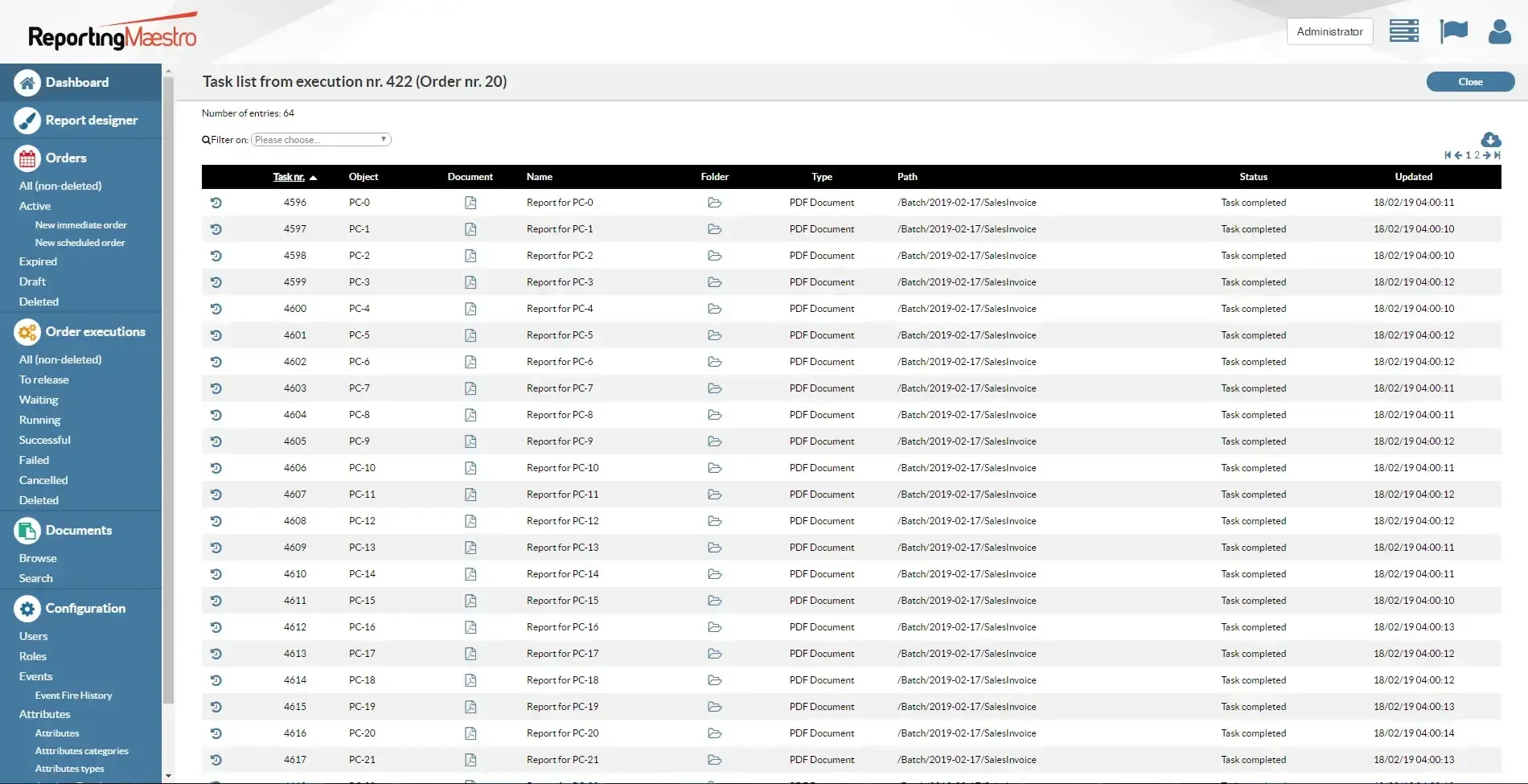
Limited visibility across the process
Each system may provide information about its own activities, but understanding the status of the complete reporting workflow can be difficult.
A reporting manager may know that document generation hasn’t started, without knowing whether the delay originated in the core banking system, a calculation service or a data transfer.
Identifying the problem can require contacting several teams and examining information from multiple applications.
Complex dependencies become difficult to maintain
As reporting requirements evolve, new processes and systems are introduced.
A workflow that originally involved three applications may eventually depend on ten.
Changes to one system can affect several downstream activities, and understanding those dependencies becomes increasingly important.
Over time, maintaining the connections between systems can require substantial IT resources.
Errors create unexpected consequences
If a process fails, what happens to the activities that depend on it?
Can they be stopped until the problem is resolved? Can the affected steps be restarted without repeating everything that has already succeeded?
Without coordinated process management, recovery can become complicated, particularly when different applications are responsible for different stages.
Auditability becomes a challenge
In financial services, knowing that a report was produced is not always enough.
Organisations may also need to establish which processes were executed, when they ran, whether they completed successfully and what happened when exceptions occurred.
When this information is scattered across different systems, reconstructing the complete reporting history can become a time-consuming exercise.
The more systems involved in reporting, the more important it becomes to manage the process as a whole rather than as a collection of individual tasks.
Imagine your reporting systems working together
Now consider a reporting operation in which the complete sequence of activities is coordinated.
The process begins when the required data becomes available.
A calculation service is called and the reporting workflow waits for its results.
Once the calculations are complete, another system is instructed to perform the next required activity.
The workflow continues according to predefined dependencies, ensuring that each stage begins only when its prerequisites have been satisfied.
When the necessary information is ready, report generation starts.
Afterwards, additional systems can be involved in validation, approval, distribution or archiving.
Throughout the process, activities can be monitored and their execution recorded.
If something goes wrong, the reporting team has greater visibility into which stage encountered a problem and which activities have been completed.
Rather than coordinating individual systems manually, the organisation manages a single, integrated reporting operation.
The systems remain specialised in what they do best, while the reporting platform ensures that they work together.
This approach creates opportunities to reduce manual intervention, improve reliability and make complex reporting workflows easier to manage.
It also makes the reporting operation more adaptable.
When business requirements change, the organisation can adjust the workflow and its interactions with other systems without necessarily replacing the underlying applications.
Reporting orchestration: the conductor behind the operation
An orchestra consists of musicians playing different instruments, each with a specific role.
The musicians may be highly skilled, but delivering a successful performance requires coordination.
Some instruments begin together. Others enter later. Certain passages depend on precise timing, while others require different sections to work in harmony.
The conductor doesn’t replace the musicians or play their instruments.
The conductor ensures that their individual contributions come together as one coordinated performance.
Complex reporting operations face a similar challenge.
Core banking systems, calculation engines, data services, document generation tools and distribution platforms each perform specialised tasks.
But delivering reliable reports requires these systems to work together in a carefully coordinated sequence.
This is the principle behind Reporting Maestro.
Rather than simply generating documents, Reporting Maestro can orchestrate the activities required throughout the reporting lifecycle.
Through configurable and customisable connectors, it can interact with existing applications and services at different stages of the process.
For example, Reporting Maestro can wait for one system to complete its processing, request another system to perform calculations, wait for those results, generate the required documents and then initiate further activities in other systems.
These interactions can be incorporated into controlled workflows that support reliable, auditable and scalable reporting operations.
And because Reporting Maestro works with existing systems, organisations can improve coordination without necessarily replacing the applications in which they have already invested.
From disconnected processes to a controlled reporting operation
At ReportingSoft, we help financial institutions bring complex reporting processes together.
Our Reporting Maestro platform is designed not only for high-volume report production but also for orchestrating the systems and activities involved in preparing, generating, distributing and archiving reports.
Its configurable connectors allow organisations to integrate existing applications into reporting workflows, including interactions that require external systems to complete their work before subsequent activities can proceed.
Reporting Maestro’s orchestration capabilities have been used by banks across Europe for 18 years, coordinating complex reporting processes involving multiple interconnected systems.
Combined with production monitoring, error handling and traceability, Reporting Maestro helps organisations manage these dependencies within a more controlled and transparent reporting environment.
The result is not simply a faster report-generation process.
It is a reporting operation in which systems work together more predictably, manual coordination is reduced, and reporting teams have greater visibility and control.
Who is conducting your reporting operation?
Think about the systems involved in producing and delivering your organisation’s reports.
How many separate applications contribute to the process?
How many scheduled jobs, scripts and manual procedures are needed to coordinate them?
What happens when one system takes longer than expected, or a process fails?
And can your team easily establish which activities have been completed and which are still outstanding?
If your reporting operation depends on numerous interconnected processes, the challenge may not lie in any individual system.
It may lie in how those systems work together.
Your reporting team shouldn’t have to conduct every run manually. With the right orchestration platform, they can concentrate on delivering the results.
Orchestrate your reporting system
Discover how ReportingSoft helps bring your existing systems together into a more reliable, scalable and auditable reporting operation.
Request a demo